Choosing between sliding and swing gates is one of the first practical decisions you will face when planning an automated entrance. Both configurations can be elegant, secure, and reliable — but they suit different driveways, and selecting the wrong one leads to compromises you will notice every day.
This guide compares the two approaches honestly, so you can discuss options with confidence before your site survey.
How swing gates work
Swing gates operate on hinges attached to gate posts. Single-leaf gates open like a door; double-leaf pairs meet in the centre and swing inward (or occasionally outward, though inward is standard for domestic properties).
Swing gates are the traditional choice for residential driveways. They suit properties where:
- The driveway is deep enough for gates to arc open without obstructing parked vehicles
- The opening is moderate in width — typically up to around four to five metres for a pair
- You prefer the classic appearance of hinged gates, particularly in timber or decorative metal
Our swing gate installation service covers everything from post specification and foundation design to motor selection and safety device integration.
How sliding gates work
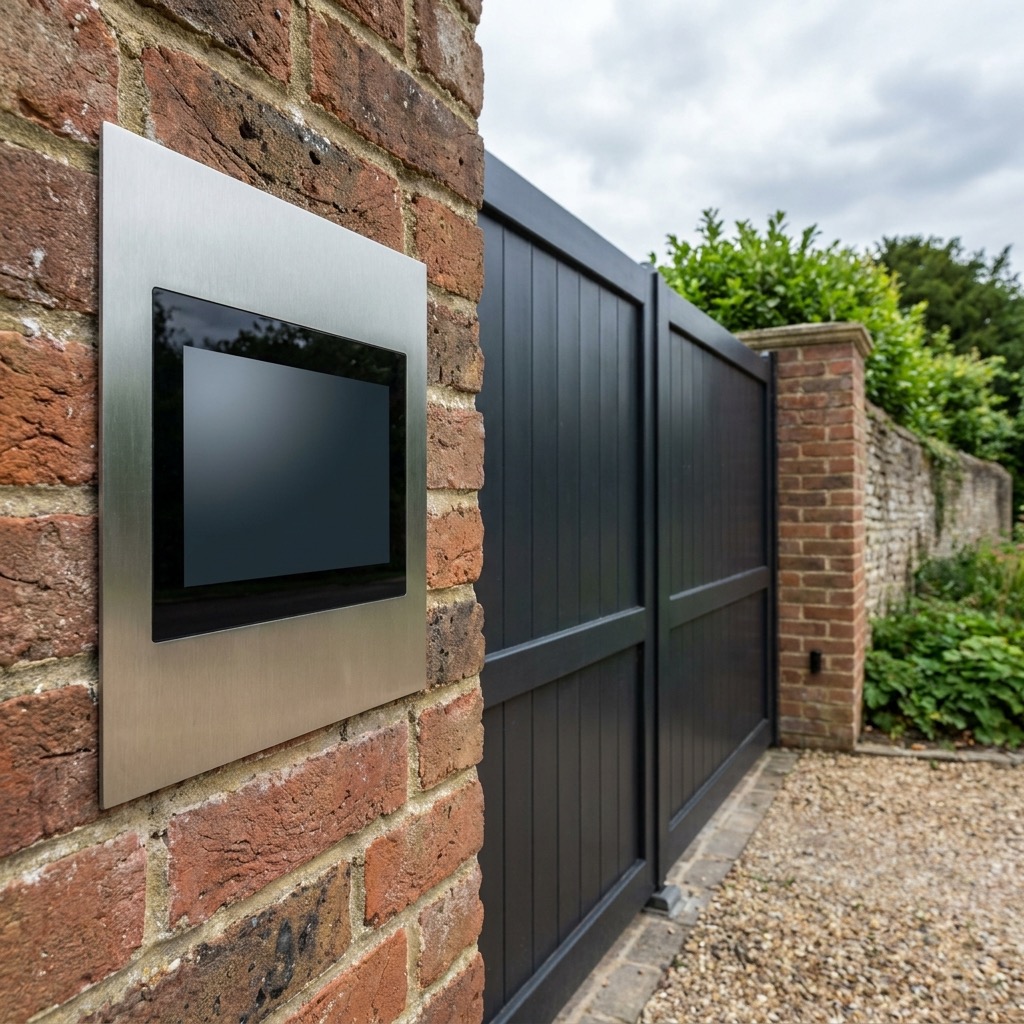
Sliding gates move horizontally along a track, stacking to one side of the opening when open. They require a run of level ground beside the opening equal to the gate width — the gate must have somewhere to slide.
Sliding gates excel where:
- The opening is wide but the driveway is shallow, leaving no room for swing arcs
- The drive slopes significantly, making hinged operation impractical
- You want maximum clear opening width without gate leaves occupying the driveway space
- A contemporary, linear aesthetic suits the property
Sliding gate systems demand careful track design, drainage, and foundation work. The track must remain clear of debris and properly aligned — maintenance is straightforward but not zero.
Key comparison points
| Factor | Swing gates | Sliding gates |
|---|---|---|
| Driveway depth | Needs clearance for gate arc | Needs lateral run beside opening |
| Wide openings | Heavier leaves, stronger posts | Often more practical |
| Sloping drives | Ground clearance can be an issue | Track must be level; may need grading |
| Appearance | Traditional, versatile | Contemporary, clean lines |
| Maintenance | Hinges and motors | Track cleaning and alignment |
| Cost drivers | Post foundations, motor duty | Track, foundation, sliding mechanism |
Neither option is inherently cheaper. Cost depends on opening size, materials, groundworks, and automation specification — typically within the £3,500–£18,000+ range for Hertfordshire installations.
When swing gates are the better choice
Swing gates remain the default for good reason on many Hertfordshire properties. If your driveway allows gates to open inward without conflict, swing systems are mechanically simpler and often easier to service.
They work particularly well for:
- Period and village properties where hinged timber gates suit the architectural character
- Moderate-width openings on drives with generous depth
- Properties where the sliding run would encroach on planting, walls, or neighbouring boundaries
In towns such as St Albans, where front gardens are compact, swing gates that open inward are often the only viable option — provided the driveway depth accommodates the arc.
When sliding gates are the better choice
Sliding gates come into their own on wider openings and shallower drives. A five-metre opening with only three metres of depth behind the gate line cannot accommodate swing leaves — but a sliding gate stacking to the side solves the geometry cleanly.
They also suit:
- Commercial-style entrances to larger Hertfordshire properties
- Sloping sites where a level track can be engineered into the landscape
- Homeowners who want the full opening width usable when gates are open, with no leaves occupying the driveway
The trade-off is the lateral space requirement. If there is no room beside the opening for the gate to stack — because of a wall, fence, or boundary — sliding is not an option regardless of other advantages.
Automation considerations
Both configurations require appropriately rated motors, safety devices, and control systems. Swing gate motors (articulated arm, underground, or linear) differ from sliding gate motors (rack-and-pinion or chain-driven), but the safety requirements are identical.
Photocells, obstacle detection, and safe operating forces are mandatory under UK standards. We cover the full safety landscape in our article on gate automation safety devices.
Access control — remotes, keypads, intercoms — works equally well with either configuration. If you expect frequent visitors, integrating access control and intercom during planning saves retrofit costs later.
The best gate configuration is the one your driveway geometry supports — not the one you saw on a neighbouring property.
Can you automate existing gates?
Often, yes. If your current manual swing or sliding gates are structurally sound, electric gate installation may involve retrofitting automation rather than replacing the leaves entirely. A site survey establishes whether existing gates have sufficient structural integrity and suitable geometry for safe automation.
Making the decision
The right configuration becomes clear once your opening is measured, your driveway is assessed, and your daily usage patterns are understood. That is precisely what a site survey evaluates.
For broader context on budgeting and planning, see our guides to planning electric gates in Hertfordshire and electric gate costs.
Discuss your driveway with us
Every property is different. Request a free site survey and we will assess your opening, recommend the most suitable configuration — swing or sliding — and provide a clear quotation for automatic driveway gates tailored to your home.